400G ZR+ vs. a Mid-Span Site: How to Solve Fiber Links Over 40 km
Link too long for standard optics? Compare 400G ZR+ and 100G ZR coherent optics with building a mid-span cabinet or fiber hut: cost, reach, link budget and port compatibility.
The 30-second version
- If a fiber link is too long for your standard optics, you don't have to build a site in the middle.
- Long-reach optics that plug into your existing routers can cover about 90 km on their own.
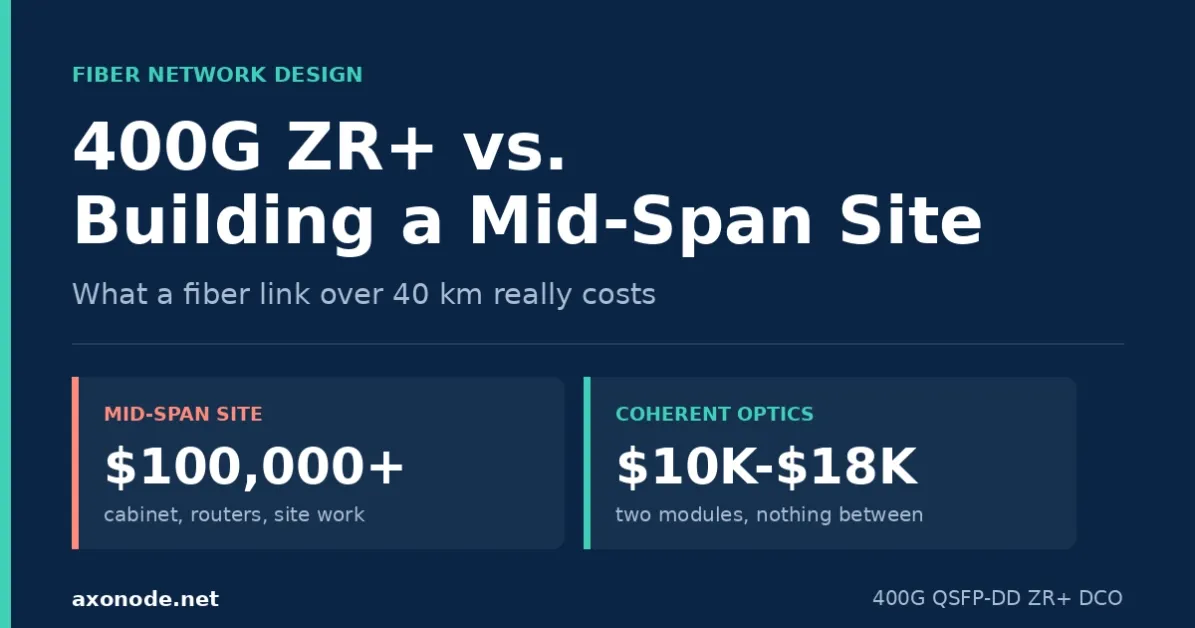
- A pair costs about $10,000–$18,000. A mid-span site usually costs over $100,000, plus maintenance every year.
- The catch: they only fit certain router ports. Have your engineer check the five points below before you order.
Short answer: For a point-to-point fiber link beyond 40 km, a pair of coherent optics costs about $10,000–$18,000. Coherent optics are long-reach modules that plug into a standard router port. A mid-span site costs far more once you add the cabinet or shelter, routers, site work and maintenance. A high-power 400G ZR+ (QSFP-DD DCO) module can cover roughly 90 km of unamplified dark fiber.
The situation
It's a common discovery for rural ISPs and utility fiber networks building out rural broadband backhaul. You map your routes and find that one or two links are longer than your standard optics can reach, often 40 km or more.
The instinctive fix is to break the link in the middle: place a cabinet or fiber hut halfway, add a router, and run two shorter hops. It works, but it's usually the most expensive way to solve a reach problem.
Option 1: Build a mid-span site (cabinet or fiber hut)
A mid-span site is more than a box on a pad:
- Outdoor telecom cabinet with climate control, DC power and batteries. A well-equipped unit costs tens of thousands of dollars.
- Carrier-grade routers, often tens of thousands of dollars each, and many operators install two for redundancy.
- Site work: permits, concrete pad, commercial power, and sometimes land or an easement.
Telecom shelter cost is higher still. A new prefabricated concrete shelter, often called a fiber hut, typically lists at $50,000–$70,000 for the building alone. Land, pad, crane, power and fencing can multiply that.
After installation, every site keeps costing money: truck rolls, HVAC and battery maintenance, and one more point of failure.
Option 2: Use coherent optics end to end
Coherent optics plug directly into the router at each end of the link. There's no intermediate site, no extra router and no land. This is the basis of IP-over-DWDM designs, where the transport function moves into the router itself.
The two common types are 400G ZR/ZR+ in a QSFP-DD port and 100G ZR in a QSFP28 port. QSFP-DD and QSFP28 are the physical port types on your router.
At public list prices, a 400G ZR+ module costs roughly $5,000–$9,000, so a pair runs $10,000–$18,000 per link. That's expensive compared with standard optics, but the comparison that matters is against the site it replaces.
Coherent optics vs. mid-span site: side-by-side
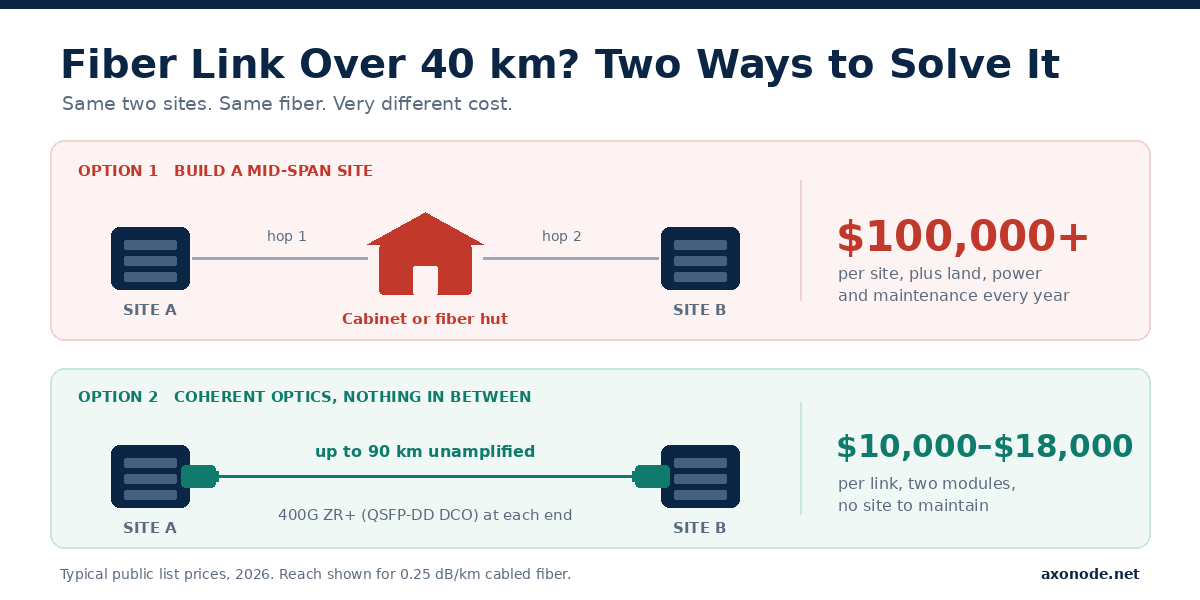
| Mid-span site | Coherent optics | |
|---|---|---|
| Hardware | Cabinet or shelter + router(s) | 2 pluggable modules per link |
| Typical cost | $100,000+ per site | $10,000–$18,000 per link |
| Site work | Pad, power, possibly land | None |
| Ongoing costs | HVAC, batteries, truck rolls | Minimal |
| Lead time | Months (permits, construction) | 4 weeks |
Five things to check before choosing coherent optics
This section is for the engineer doing the link planning. If you're making the budget decision, the table above is what you need.
1. Fiber link budget: span loss, not just distance
Loss decides whether a module will work, not distance alone. Span loss is how much signal the fiber loses end to end. For fiber loss per km at 1550 nm, plan on about 0.25 dB including splices, then add connectors and margin.
Example link budget with a high-power 400G ZR+ DCO module:
- Link: 70 km × 0.25 dB/km = 17.5 dB, plus about 2 dB for connectors and margin = about 19.5 dB
- Module budget: minimum Tx power 3 dBm minus Rx sensitivity −22 dBm = 25 dB
- Result: about 5.5 dB of headroom. The link works.
Datasheets for this class of module typically rate about 90 km unamplified at 0.25 dB/km, which is 22.5 dB against a 25 dB budget. Newer low-loss fiber can go further, older routes with extra splices will not, so use your OTDR results: the fiber test report from your splicing crew.
One detail people miss: in high-power gray mode the receiver accepts a maximum of 0 dBm. On a very short link, under about 15 km, add an attenuator so you don't overload it.
Chromatic dispersion is usually a non-issue here. A 400G ZR+ module tolerates around 20,000 ps/nm at 400G, so no dispersion compensation modules are needed on spans of this length.
2. 400G ZR vs. ZR+: not the same
Standard 400ZR runs at low transmit power. It was designed mainly for amplified DWDM systems, networks with optical amplifiers along the route, so its unamplified reach is limited.
High-power ZR+ modules add a single-wavelength gray mode for point-to-point dark fiber, with about +4 dBm output. That's what makes 80–90 km unamplified links possible. With amplification, the same module reaches 450 km at 400G.
Look for compliance with Open ZR+ MSA and OIF 400ZR. Those are the standards that define how the module behaves, and they're what makes multi-vendor interoperability possible.
If a vendor quotes a reach figure, ask one question: amplified or unamplified?
3. Router port type: QSFP-DD vs. QSFP28
This is the most common and most expensive mistake. 400G coherent modules need a QSFP-DD port. Many aggregation routers in rural networks have 100G QSFP28 ports, and a QSFP-DD module won't fit.
If your routers have QSFP28 ports, look at 100G ZR QSFP28 coherent (DCO) modules. Depending on transmit power, they reach roughly 80–160 km unamplified, with no router replacement.
We can source 100G ZR coherent modules on request, so tell us your port type and we'll quote the right one. Don't confuse those with 100G ZR4, a direct-detect module that tops out around 80 km and behaves very differently. The names look almost identical on a quote. Coherent modules say DCO or coherent; if a datasheet doesn't, ask.
4. Power class and cooling
A 400G ZR+ module draws about 22 W, and up to 23 W in some client modes. That's several times more than standard optics. 100G ZR QSFP28 coherent modules draw around 5–6 W.
Check that the port supports QSFP-DD Power Class 8, which covers modules above 14 W. Many older 400G ports top out at Class 7, which is 14 W, and will not bring a ZR+ module up.
If you plan to run several 400G ZR+ modules in one router, check your vendor's guidance first. Some platforms limit how many high-power modules they support, restrict which ports can take them, or require a higher fan setting.
Also check case temperature. These modules are typically rated 0 °C to 75 °C, so the routers at each end should sit in a climate-controlled building or cabinet.
5. Platform compatibility
Coherent modules need more than the right port. Your router's software has to recognize the module and let you configure it: wavelength, output power and operating mode. Check two things:
- Your platform and OS version support coherent ZR/ZR+ modules. Look for CMIS and C-CMIS support in the release notes.
- For third-party optics, the module is coded and tested for your platform, whether that's Cisco, Arista, Juniper or Nokia.
When you still need a mid-span site
Coherent optics don't replace every site. You still need one when:
- You need to drop or add traffic along the route
- The link needs optical amplification anyway
- You need a branch point for future expansion
If none of these apply, the mid-span site is probably an expensive answer to a reach problem.
FAQ
How far can 400G ZR+ go without an amplifier?
A high-power 400G ZR+ module has about 25 dB of optical budget, roughly 90 km of cabled fiber at 0.25 dB/km. Actual reach depends on your measured span loss, so use OTDR results rather than distance alone.
What is the difference between 400G ZR and 400G ZR+?
Standard 400ZR runs at low transmit power and targets amplified DWDM networks. High-power ZR+ adds a single-wavelength gray mode at around +4 dBm for unamplified point-to-point dark fiber, reaching 80 to 90 km, and up to 450 km on amplified links at 400G.
Can I use a 400G ZR module in a 100G QSFP28 port?
No. 400G ZR modules need a QSFP-DD port. For QSFP28 ports, use 100G ZR coherent DCO modules, which reach roughly 80 to 160 km unamplified depending on transmit power. Do not confuse those with 100G ZR4, which is direct-detect and tops out around 80 km.
Is coherent optics cheaper than building an intermediate site?
In most point-to-point cases, yes. A pair of 400G ZR+ modules costs about $10,000 to $18,000. A mid-span site with a cabinet, routers and site work typically exceeds $100,000, before land, power and yearly maintenance.
How do I calculate a fiber link budget?
Multiply the distance by about 0.25 dB/km at 1550 nm, then add about 2 dB for connectors and margin. Compare the total with the module's optical budget, which is its minimum Tx power minus its Rx sensitivity. A 70 km link needs about 19.5 dB against a 25 dB budget, leaving 5.5 dB of headroom.
What power class does a 400G ZR+ module need?
A 400G ZR+ module draws about 22 W and needs a port that supports QSFP-DD Power Class 8, which covers modules above 14 W. Many older 400G ports top out at Class 7, which is 14 W, and will not power the module.
What information do I need to choose the right coherent module?
You need the router model and port type at both ends, the link distance, the measured span loss from an OTDR report if available, and whether the link is amplified.
Not sure which module fits your link?
Send us the router models at both ends, the link distance and your OTDR loss if you have it. We'll run the link budget, match the module, and tell you honestly if a coherent pluggable won't do the job. You'll get an answer within one business day.
Get a free link feasibility check →
Pricing reflects typical public list prices at the time of writing and varies with platform coding and volume.
Related products: 400G QSFP-DD coherent modules · DWDM optics
Written by Jenny, manager at Axonode, helping ISPs and utility fiber networks choose optics for long-distance and rural links.