
Industrial vs. Commercial Temperature Optical Transceivers: What Really Matters?
Commercial 0–70°C or industrial -40–85°C optics? Learn what Tcase means, why cabinet air differs from module temperature, and what to verify before deployment.
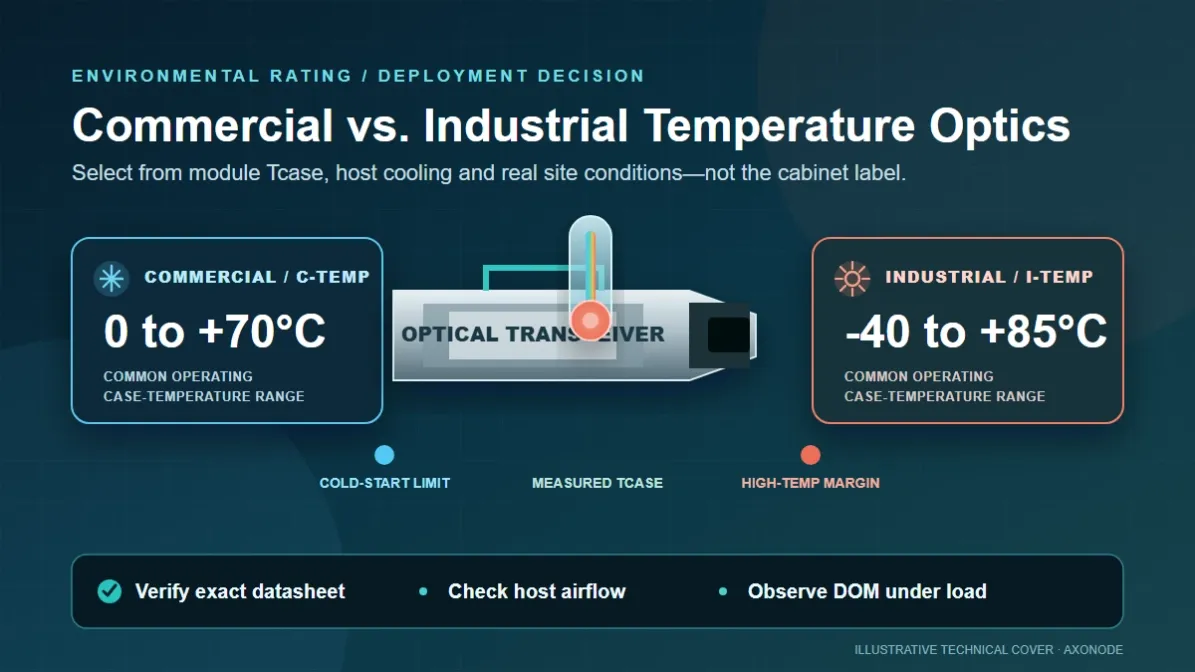
A wider temperature rating can be necessary for an outdoor network. It cannot compensate for an unknown module temperature, inadequate airflow or a host that was never designed for the heat.
A temperature grade is one of the easiest specifications to compare on an optical transceiver. Commercial: 0 to 70°C. Industrial: -40 to 85°C. The second number looks like the safer choice for a remote cabinet, particularly when the equipment is expected to stay online through summer heat and winter cold.
But that comparison skips the most important question: the temperature of what?
An optic is not sitting in the open air. It is plugged into a switch or router, often beside other warm ports, processors and power circuitry. A cabinet thermometer might be several degrees away—physically and thermally—from what the module is experiencing. Paying for an industrial part does not resolve that difference.
01The number on the datasheet is usually Tcase
For pluggable transceivers, the familiar operating grades generally describe the module case temperature (Tcase), not the outdoor air temperature. The QSFP-DD MSA hardware specification and Cisco's industrial-optics white paper use the following ranges:
The module is specified to operate within this common case-temperature window.
A wider window, but not the same low-temperature limit as industrial.
Operation is specified across a much wider case-temperature window.
These are common industry classes, not a substitute for the exact part-number datasheet. Some products have different lower limits or special startup conditions, and not every 400G optic is offered in every temperature grade.
There are at least four temperatures involved in a real installation: the weather outside the enclosure, the air inside it, the air reaching the host's cooling path, and the module's case temperature. The laser and electronic components inside the module have their own internal temperatures as well.
A manufacturer's Tcase rating relates to a defined measurement point on the module housing. The MSA places responsibility on the equipment maker to keep the module in its specified case-temperature range using the host's thermal design. A rugged cabinet label tells you nothing about that module-to-host interface by itself.
02A 50°C cabinet is not necessarily a 50°C optic
Consider a cabinet whose sensor reads 50°C during a hot afternoon. The cabinet may be functioning exactly as designed. A commercial optic rated to 70°C could still have very little thermal margin if the port runs substantially warmer than the air around it.
Cisco's white paper describes a rough 20°C case-to-ambient rise as a rule of thumb for some installations. Applied mechanically to this example, that would put the module at 70°C—right at a typical commercial limit. But the difference is not a universal 20°C constant. It changes with the equipment, port density, power draw, airflow, adjacent modules and where the cabinet sensor is located.
The useful measurement is the one taken from the actual host and optic, under representative conditions. A reading collected after the cabinet door has been open for ten minutes is not the same as a reading during normal, closed-door operation. Neither is a brief link-up test a substitute for observing temperature over a sustained traffic period.
A higher-rated optic may be justified, but the first action is to find out how hot the installed optic becomes.
03Industrial-rated does not mean self-cooling
The distinction matters more as transceiver power rises. An industrial module can be designed and qualified to work at a higher case temperature; it does not remove the electrical power that becomes heat inside the port.
Take a published product as an example. The Axonode 400G ER4 40km QSFP-DD lists 0 to +70°C operating temperature and 12W maximum power. That is a commercial-temperature specification. It should not be presented as an industrial-temperature module merely because the intended application is a remote site.
If a router uses four such optics, their published maximum power figures add up to 48W. That is an upper-bound planning figure for the optics, not a measured steady-state heat reading. The host still has to dissipate that load together with the rest of its electronics. The QSFP-DD hardware specification defines multiple power classes and makes the system designer responsible for keeping the module within its case-temperature requirements. The form factor alone does not establish one fixed thermal load.
Even a genuine -40 to +85°C module does not make the router, power supply, heat exchanger or enclosure capable of operating at those temperatures. The host may have a narrower approved operating environment or limits on which high-power optics can occupy adjacent ports. Temperature grade and platform support have to be checked together.
04The cold end can be just as misleading
Most purchasing discussions focus on heat. In utility networks, roadside access cabinets and mountain installations, the more difficult test may be what happens after an overnight outage in freezing weather.
A data sheet might specify a wide storage temperature range even when its powered operating range is much narrower. For instance, a commercial module can be stored at -40°C without being specified to carry traffic at -40°C. Storage survival is not cold-start performance.
Some industrial transceivers also distinguish between low-speed management access and live optical operation during a cold start. Cisco documents examples where management functions are available at -40°C but full traffic operation begins only after the module warms to a higher threshold. The exact distinction is product-specific.
For an unmanned site, that detail is operational rather than academic. If power returns at 5 a.m. after a winter outage, can the link establish immediately? Does the host delay bringing up the optic? Is a cabinet heater part of the design? A part number with “-I” in its name does not answer those questions on its own.
05What should be verified beyond the temperature label?
A trustworthy industrial rating should be supported by documentation for the specific optical module. The first document is its current datasheet: exact operating case-temperature limits, electrical power, optical specifications, host interface and any startup restrictions. A generic family brochure is less useful when the proposed unit is a particular 25G BiDi, 100G LR4 or 400G ER4 variant.
The second piece is the host environment. Identify the router or switch model, software version, port arrangement and cooling configuration. Is airflow front-to-back or side-to-side? Are there limits for high-power optics, port groups or allowable ambient temperature? An optics supplier cannot infer those conditions from the word “hardened.”
Then look at monitoring. Digital optical monitoring (DOM/DDM) can expose module temperature, transmitter and receiver optical power, bias current and supply voltage. Those values are useful for watching temperature excursions alongside link errors. They are not necessarily a laboratory measurement of the hottest component. Sensor location, accuracy and reporting behavior depend on the module. Molex's discussion of optical-module thermal characterization explains why a case-temperature reading is an imperfect proxy for internal component temperatures.
Finally, qualification should reflect the use case. A warm-room compatibility check may confirm host recognition and link establishment, but it cannot establish operation throughout an industrial temperature range. Evidence is more meaningful when it includes temperature-dependent optical performance, link stability, relevant error or FEC counters, thermal cycling or cold-start behavior as applicable. If a supplier has not performed a particular test, that limitation should be stated rather than filled in with a general reliability claim.
- ✓ Exact part number and current datasheet
- ✓ Host model, software and supported power class
- ✓ Port airflow, density and adjacent high-power modules
- ✓ Representative closed-door module temperature
- ✓ Cold-start and storage-versus-operating limits
- ✓ DOM readings, link errors and qualification evidence
06So is industrial always the better purchase?
Not automatically.
A commercial optic can be a reasonable engineering choice in a temperature-controlled equipment room or a properly cooled enclosure where its actual case temperature stays within the published limits, with the margin required by the operator's design. Buying an industrial version solely because the site is geographically outdoors may add cost without addressing the real risk.
An industrial optic becomes much more relevant when the measured or conservatively validated case-temperature extremes exceed commercial limits, especially where heating and cooling cannot be guaranteed. Extended-temperature options may also be appropriate for certain sites, provided the exact temperature and startup requirements match.
There is another possibility: the module rating is not the constraint. If the host cannot keep a high-power optic within its approved operating conditions, the better answer may be a different port layout, a lower-power interface, improved cooling or a different platform—not a more expensive transceiver with a wider temperature label.
The practical purchasing question is therefore not “Is this industrial grade?” It is “Will this exact module remain within its specified limits in this exact port, through the site's worst operating conditions?”
That's a harder question, but answering it tends to save time during qualification and prevent surprises after deployment.
For a deeper look at the 400G-specific side of the problem, read our guide to 400G optics in outdoor cabinets.
Prepare the thermal inputs before requesting optics
If you're selecting optics for a remote ISP, utility or access-network cabinet, send Axonode the host model, required data rate and reach, expected temperature range and any available DOM readings. We can help compare the published limits and identify what still needs testing before a larger order. You can also write to jenny@axonodesolution.com.
Technical references


